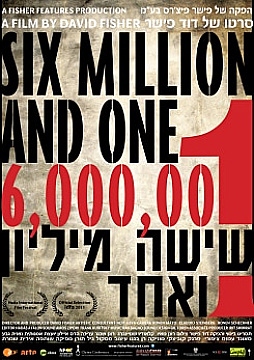
Six Million and One
A family's journey tracing the origins of the father's diary during the Holocaust
The Memoir
My siblings didn't want to read our father's memoir. Perhaps because he had spent his whole life in silence. Who knew what demons might come leaping out of a place that had been shut away for so many years?
I opened it.
Auschwitz. Mauthausen. Gusen. Gunskirchen. Murder. Beatings. Hunger. Cannibalism. Homosexuality.
The demons were celebrating.
Some names and issues were familiar. Others seemed to be weird, hallucinatory, nightmarish. I set out on a quest to decipher them.
I made half the journey alone. I forced the second half on my siblings, who didn't want to participate, even while they were crawling around tunnels and enchanted forests.
This isn't a film about the Holocaust, because we spent most of our time laughing and there is nothing funny about the Holocaust; it's about a rare kind of intimacy and sibling bond that replaced pain with bittersweet humor.
Why Six Million and One
My father was liberated from the last camp freed in WWII, on its final day. He was among the very last prisoners to leave. He walked into the forest. He had no strength left. He sat down, leaned against a tree and waited to die.
An American jeep came by. They picked him up. He survived. He made it to Israel, started a family.
I am his son.
But he came very close to becoming a victim. There were six million victims of the Holocaust. If my father had died, the number would have been six million and one. Hence the name of the film.
My father was a simple working man, roads, water pipes, infrastructure. After he died, I discovered the diary he had written. And found, in the words of a laborer, the mind of a writer. A man of roads and water pipes, writing as an intellectual, without a trace of self-pity.
I hear my father's inner voice as he writes. I look over his shoulder. I see his face from the front: clenched. His teeth grinding. His lips bitten.
He bites his lips.
He pricks himself.
A drop of blood.
A tiny pain.
Perhaps an attempt, one that does not quite work, to hold on to a physical sensation. Anything rather than disappear into madness. Into his thoughts. He keeps writing. He forgets the struggle. There is only what he remembers. And now it flows. It flows in fragments, by association, one memory pulling another behind it. How do you put it all in order? Will I have enough time, he asks himself. He stops writing. The doubts begin to eat away at him. And when doubt is eating away at you, who can concentrate on writing? Who can be free enough to write?
— David Fisher
That is the beauty of humanity. That we are capable of creating horror, but also capable of creating beauty out of horror... Six Million and One is such a beautiful scar
Eliane Brum, Revista Época, Brazil
An unconventional family, atmosphere, and setting in a very unconventional film. When a documentary film manages to make you laugh and touch your heart—watching it becomes an experience
Yehuda Stav, Yedioth Ahronoth
I walked in a skeptic, I walked out crushed
Yair Raveh, Pnai Plus
Director David Fischer dares to pit his family's private troubles against the Holocaust, and succeeds
Meir Schnitzer, Maariv
A fascinating mixture of closeness, love, pain, and jokes
Nirit Anderman, Haaretz
...A fascinating documentary Holocaust film... The family drama during the journey unfolds against the backdrop of exposing, presenting, and depicting fascinating and little-known biographical and historical materials
Yishai Kichales, Israel Hayom
Austria Confronts Its Past
The film is a contemporary journey of the filmmaker against a historical backdrop. It is a journey that would not have been possible twenty years ago. It is a search made possible today through the perspective of time, and in this lies the power and uniqueness of this film over many other Holocaust films. The journey, centered on the discovery of his life as a prisoner in the Guzen concentration camp, reveals for the first time the struggle of local residents against the Austrian authorities to preserve the forced-labor sites and to allow visits and ceremonies at the location. Austria, a country that prefers to forget its past and also treat its role as a victim of the war, stands here before the strong will of a handful of residents to remember what their parents and grandparents did, and to warn the younger generation against xenophobia and the denial of freedom. The film consists of close observation of what takes place in the Guzen 1, 2, and 3 camps, and in the peaceful villages living there today.
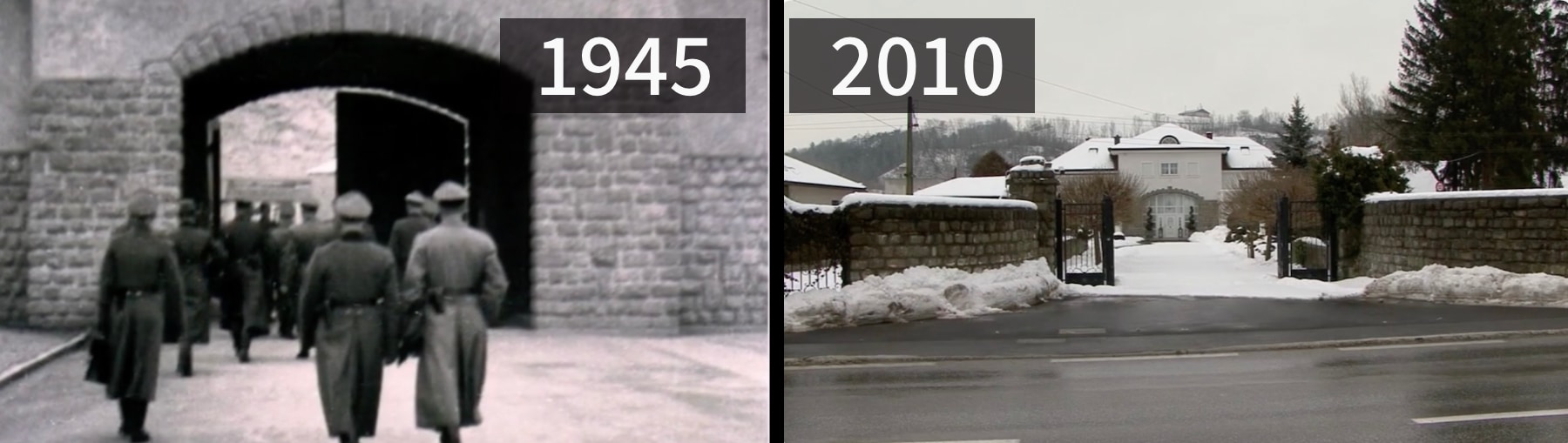
In the image: The Gestapo interrogation facility in Gunes, Austria, then and now.
From Yosef Fisher's Diary
"This is the fourth time I am trying to write the story of my life and what I remember, more or less, from my childhood until now, June 1994, when I am so happy and looking forward to a grandchild who will soon, God willing, be born to Ronel and Michal. I hope that this time I will have strength of mind not only to begin, but to keep going and leave some kind of document behind me, since I never managed to accumulate any property... To tell the truth, my deterioration and lack of sleep began three or four years ago. From the moment the boys left home, the restraints were released, and apparently Meli feels freer too, and sighs more often..."
"One morning an order came that all the Jews from New Street were to come, with their bundles, to the Great Synagogue. My mother sewed a backpack for each child and filled it with rusks, rice, sugar and other provisions... My father and I were the last ones left. It is hard for me to describe those final moments at home. My father took a sharp knife and cut open the feather quilts and destroyed everything of value in the house. I stood there frozen. I was in shock. Yes, before that he took the violin, removed the strings, broke the bow, destroyed the guitar, the bass and the drums. He did it with determination and hardness. I did not see any tears in his eyes. All of this took only a few moments. I was left stunned."
"We were building tunnels under a mountain... digging with a pickaxe and shovel, carrying building materials and pouring concrete. The skilled workers and the managers were civilians from different countries. They usually did not mistreat us. Sometimes they would even bring us a piece of bread, or even some sausage. But the kapos, Ukrainians and Poles, would beat us for no reason at all. Whoever they picked on would return to the camp a broken man, weakened, unable to report for work. Usually, he got diarrhea and died... The mind cannot grasp what it means to beat a person for no reason until he collapses. To curse and abuse him the whole time. From there, I did not think I would come out alive."
"After staying there for several days, they marched on us again for about three days. At night we slept under the open sky. It rained... I was terribly cold... The next morning, we continued the march. I remember chewing grass like an animal. I also collected snails and sucked them. I collected some to save for the evening. I thought that for a few snails someone would let me cook them. But the greater the expectation, the greater the disappointment. They all escaped from my jacket pocket. I was very, very sad."
"Looking back, I am not sure that today I would fight so hard for my life. The will to live was important, perhaps because by then we already knew that we no longer had a family, and I even imagined that we Jews were almost the only ones still alive... At night I would sneak into one of the buildings and fall asleep beside someone who did not throw me out. You can probably guess why he did not throw me out. That's right."
"At the moment of liberation, I was lying in the forest... on a blanket I had managed to get for myself... Suddenly I saw the German soldier coming down from the watchtower and leaving... Suddenly I heard shouts of joy and the noise of tanks, and Bezalel, a man from my hometown who was stronger than me, came running over. He brought all kinds of tins of canned food and told me to keep them; he was going to get more. But instead of bringing more, he came back with his face covered in blood. Someone hit him on the head. I stood beside him, not knowing what to do. Then he said to me, 'Pee on my head. "Pish pish, Yos'le."'"
The Trauma of the Liberators
My father could not write about what happened in the Gunskirchen forest, the camp where his ordeal ended. It was too horrible. So, I went to the American soldiers who liberated the camp. But they, too, carry a traumatic memory. When I complained that my father had never told us what he had been through, they said perhaps it was better that way. That there was no way to tell a story like this.
In the film, one of the veterans, Pete Karnbouchi, says: "It is almost impossible to explain or describe what we saw, what happened to us at the Gunskirchen gate. You cannot explain to people how inhuman human beings can be toward other human beings. We saw the worst of the worst. It has to be the worst. I have never seen a horror film that comes close to what we saw, what we heard, what we smelled."
Festivals and Awards
Best Film Award at the DOK.fest Festival in Munich, Directing Award at the Krakow Film Festival, Honorable Mention at the DOXA Festival Vancouver, Official Selection at the IDFA Festival in the Netherlands. Opening film of the Crossing Europe Festival Linz (Austria). Israeli Minister of Culture Award for Zionist Creation.
Co-production Israel (YES Docu) – Germany (ZDF arte).
Student or Faculty?
Watch all movies for FREE
Access through your university or college
Login through your university / college